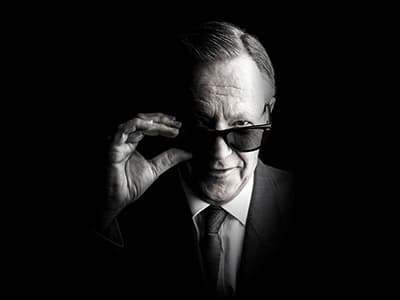
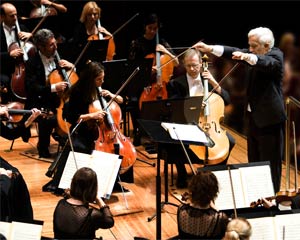
 Left - Ashkenazy and the Sydney Symphony. Photo - Brendan Read
As a Mahler aficionado who regards Das Lied von der Erde as an almost impossibly wonderful work, I was looking forward to the SSO’s performance under Ashkenazy on the 29th May with unbridled enthusiasm. I was looking forward less to hearing the suite from Strauss’ opera Rosenkavalier just before it, which I had anticipated would be like having four desserts all covered with Viennese whipped cream before the main course.
Had I not been reviewing the concert, I would indeed have only gone in for the Mahler, despite the fact that the inclusion of the Strauus was a very interesting bit of programming on the part of the SSO, the piece having been written just two years later than Das Lied.
But I was wrong. Ashkenhazy’s reading of the score divested it of all the Schlagsahne (where did he put it??). It was clear, clean, and contrapuntal; all the parts were audible, the fluctuating harmonic sense of the music was perfectly conveyed. Ashkenazy is a wonderful musician, and his experience as one of the truly great pianists of the second half of last century shows in his conducting in his refusal to neglect anything in the score. The orchestral sound Ashkenazy achieved was brilliant and Russian rather than squashy and Viennese. Ignoring Strauss’ own injunction to conductors (“Never look at the brass section, it only encourages them”) Ashkenazy looked at them often, and when the trumpets played loudly they were often a little sharp, but the concentration he elicited, especially from the woodwind, was vibrant. (Incidentally, despite the program notes insisting on the trumpets and timpani in the piece which opened the concert, Mozart’s overture to The Marriage of Figaro, which took less time to play than it did to read the program notes, they were hardly audible in it.)
So, after the interval, The Song of the Earth, that fantastic outpouring of Weltschmerz that Mahler constructed around Chinese poems, mainly by Li Po, whose Taoist aesthetic is at the opposite pole from that of late romantic decadence. Strange how such contradictions abound in - one might even say, are the life blood of - Mahler’s music. Three songs for tenor, interwoven with three for contralto, which Mahler nevertheless referred to as a symphony. And Ashkenazy conducted it like a symphony. Stuart Skelton’s powerful Heldentenor, and polished diction, conveyed the drunken craziness of The Drinking Song of Earth’s Sorrow, and his two other, slighter songs, with great intensity, but was from time to time overwhelmed by the orchestra, not so much its volume but its sheer brilliance of timbre. Skelton seemed to be aware of this. He has a big voice, but to cut through the sound the conductor was getting from the orchestra you’d need to be Siegfried Jerusalem.
The contralto songs were sung by the Finnish mezzo-soprano Lilli Paasikivi, “a warm voice from a cold country” as her website declares. I loved her voice, and it seemed to me very well suited to the peculiarly heart-wrenching loneliness of The Lonely One in Autumn. Then in Of Beauty she flirted along with the women at the beginning, she was glittering steel (and so were the brass section) when the knights in shining armour rushed past, and finally full of longing when they had gone.
Everyone waits for the final song, as long as all the other five put together, Mahler’s farewell to the nineteenth century and to life. A friend remarked to me after the concert how in this song the tunes, which begin with such intensity, are constantly disintegrating, a fact which underpins the sense of the inadequacy of life which imbues the whole work. I have never heard the interlude between the two poems on which The Farewell is based played so terrifyingly - the snarls from the trombones on low C were breathtaking. From then on the rapport between orchestra and singer was indissoluble. Paasikivi sang the closing stanza, the one which Kathleen Ferrier could never get through without breaking into tears, with deeply felt lyricism, utterly at one, I felt, with the core of the music, and consummating a performance of passionate commitment.
This particular Mahler aficionado left having been given renewed insight into this music, a diversification of understanding, and a richly sensuous experience.
Sydney Symphony presents
MAHLER’S SONG OF THE EARTH
Conductor Vladimir Ashkenazy
MOZART The Marriage of Figaro: Overture
R STRAUSS Der Rosenkavalier: Suite
MAHLER The Song of the Earth
Venue: Sydney Opera House Concert Hall
Dates/Times: 26, 28 - 29 May, 8pm
Tickets: from $35 (booking fee of $6 - $8.50 may apply)
Bookings: 8215 4600 | www.sydneysymphony.com